Reality, translated.
Pryntd transforms human experience across physical and digital environments into a unified shared reality.
Pryntd is not immersive media. It is infrastructure that translates how humans experience reality into systems that can be accessed, adapted, and scaled.

2D becomes infrastructure for reality.
2D
VR
XR
Real-Time
4D
5D
6D
Input
Intelligence
Action
It started with a simple question.
Can flat content become immersive?
- Transform landscape 2D content into VR
- Use existing content with no new production required
- Martin Luther King speech → VR experience
- Michael Jackson Thriller → immersive environment
Any 2D content becomes spatial.

Immersion became accessible.
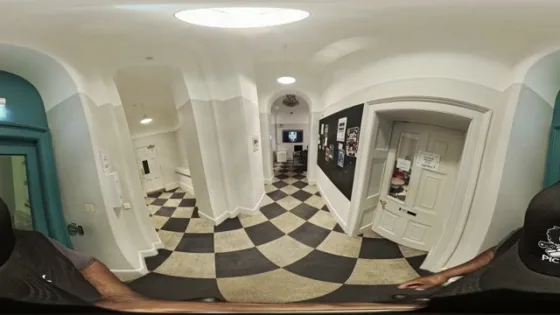
Pryntd combines video, live streams, and 360 content, then delivers immersive access through native browsers.
- Smartphones
- Tablets
- Computers
- TVs
- AR/VR devices
No hardware barrier. Reality becomes accessible anywhere.

Experiences became live.
Pryntd transforms live streams, from 2D to 360, into immersive environments with real-time interaction.
- Live video becomes spatial
- Audiences interact in the moment
- Digital environments respond as events unfold
Presence replaces passive consumption.

Reality has dimensions. So do we.
Based on space-time, Pryntd structures digital experience through 3D space and the fourth dimension: time.
- 3D: length, width, height
- 4th: time
- Interactive audiovisual virtual tours
- Time-based navigation
- Spatial interaction
- Start at any moment and move through environments
Digital experiences mirror how reality is structured.

Reality must include everyone.
Accessibility is not a feature. It is a dimension that adapts the experience without breaking the system.
- Augments visual, auditory, cognitive, attention, and perception needs
- Persistent accessibility interface at the bottom centre
- Talk, type, tap
- Real-time adaptation
- Superposition: multiple states coexist until interaction defines the experience
Reality becomes personalised without breaking the system.

Movement defines reality.
Humans experience reality through six degrees of freedom: position and orientation moving together as one embodied system.
Translational · Position
Forward / backward, left / right, up / down.
Rotational · Orientation
Pitch, yaw, and roll define how perspective changes.
- Traditional systems restrict movement to scroll, click, and watch
- Pryntd enables full spatial movement
- Physical motion maps into digital environments
- Users interact across space and perspective
- Physical and digital states influence each other
Pryntd enables digital environments to behave like physical reality.

Reality is sensed, understood, and acted on.
Input · Everything becomes an input.
Landscape video, live streams, DSLR cameras, 360 cameras, mobile devices, CCTV, smart cameras, IoT sensors, ticketing, audience behaviour, accessibility interactions, and operations data.
Intelligence · Data becomes context.
Spatial intelligence, behavioural patterns, accessibility needs, and operational inefficiencies become understandable in real time.
Action · Understanding becomes execution.
Agentic AI adapts accessibility, optimises crowd flow, personalises experiences, automates operations, and coordinates stakeholders.
Interaction · Talk, type, tap.
Natural human interaction becomes a command surface for real-time environments.
Input
Intelligence
Action
Feedback
Optimisation
One continuous system. Always running. Always adapting.

One system. Multiple outcomes.
Pryntd works independently across stakeholders, then compounds in value when connected across the full experience lifecycle.
Venues
Efficiency, utilisation, revenue.
Organisers
Lifecycle control.
Creatives
Creation and monetisation.
Professionals
Integrated services.
Audiences
Inclusive participation.
Independent use. Compounded value when connected.

Language models understand text.
Pryntd understands human experience.
Across space. Across time. Across people.
We call this shared reality.