Demand
Shared
Reality.
Audiences are done accepting fragmented event experiences. One ticket, one stream or one room is no longer enough when participation, access, community and continuity are split apart.
Tell your favourite venues, organisers, artists, festivals, conferences, brands and communities that you want it the Pryntd way.


Tell them you want it the Pryntd way
What shared reality means

Physical energy

Browser access

Capture layer

Audience journey

Shared moment

Participation graph
Physical energy
Browser access
Capture layer
Audience journey
Shared moment
Participation graph
Old event reality versus the Pryntd way.
The movement works because audiences can feel the difference immediately: fragmented attendance on one side, connected participation on the other.
Dark, disconnected, passive.
Blue ticket dots, broken pathways, isolated apps and event moments that end as soon as the venue empties.
- Fragmented maps and scattered systems
- Remote audiences treated as second class
- Networking lost in the hallway
- Accessibility added too late
Connected, immersive, accessible.
One event becomes many realities inside one connected experience: venue, watch party, digital identity, creator layer, community and replay.
- Hybrid participation by default
- Persistent community before, during and after
- AI guided access, networking and context
- Audience identity that carries across events
Shared
Reality
Venue
Watch party
Identity
Community
AI guide
Commerce
Audiences are tired of fragmented experiences.
People still care about live experiences. They are just increasingly unwilling to pay premium prices for isolated moments, poor flexibility and event journeys that feel stitched together.
1
Before the eventDiscovery, tickets, access needs, travel and context are split across unrelated steps.
2
During the eventParticipation depends too heavily on physical presence and whatever each person can navigate alone.
3
After the eventCommunity, networking, replay, commerce and identity often disappear into separate channels.

The room matters, but the room cannot be the whole experience.
The visible symptoms are economic. The deeper issue is fragmentation.
Unsold seats, weak conversion, rising ticket prices and audience hesitation are not proof that live events lost cultural value. They are proof that the old event model is under pressure.
Audiences
High prices meet weak perceived value.
Audiences feel the cost first: tickets, travel, time, access friction and the risk of paying for a moment that does not continue.

Organisers and venues
Operational costs rise while visibility stays partial.
Teams have to forecast, staff, sell, deliver and prove value across disconnected tools and weak participation signals.

Creatives
Touring economics become harder to sustain.
Creators need more resilient ways to reach audiences, monetise engagement and carry community beyond one physical stop.
The future audience demands shared reality.
Audiences are no longer just spectators, ticket buyers or attendance data. They are participants, networks, community nodes and collaborators inside the event reality itself.
Participation
Not just attendance.
People want ways to shape, enter, respond, connect and return to the experience.
Flexibility
Not just one doorway.
Physical, remote, campus, cinema, workplace and home participation should all feel legitimate.

Accessibility
Not an add-on.
Adaptive participation belongs at the centre of the experience design.

Continuity
Not one isolated moment.
Events should build identity, community and value before, during and after the live moment.
Before / During / After
The event becomes a living sequence, not a one-night island.
Shared reality gives the audience a connected path into the event, through the moment and back into community once the lights come up.

Before: context

During: immersion
Beyond: community
Next: intelligence
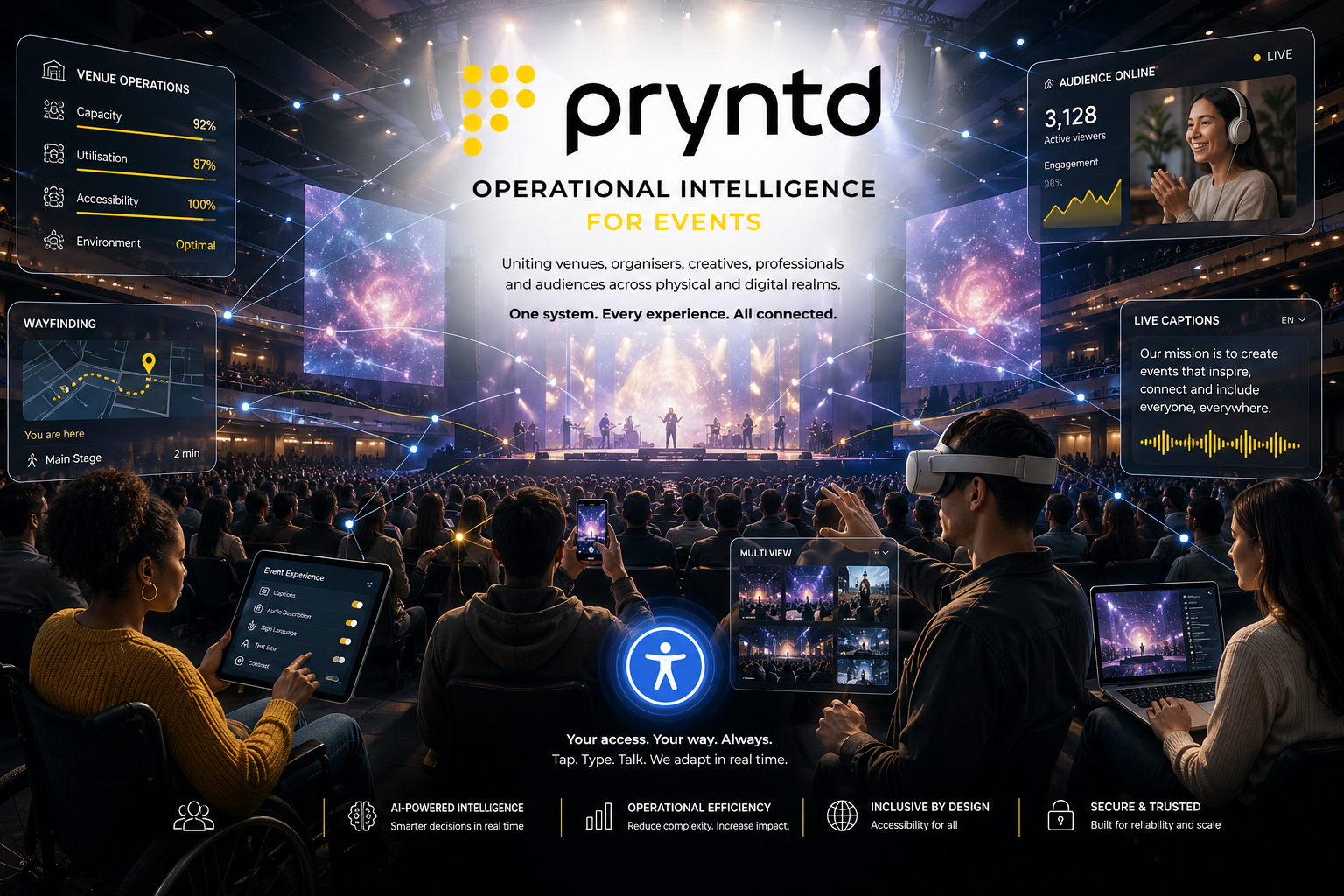
A connected event experience where physical, digital and immersive participation operate as one system.
Shared reality is what happens when events stop behaving like disconnected islands. It is the new expectation audiences can name, repeat and demand.
Different audiences. One demand.
The movement spreads because each audience group can recognise itself inside shared reality.

Attendees
Deeper physical experiences.
The room should feel richer, more contextual and more connected to what happens next.
Remote participants
Flexible participation without travel friction.
Remote should not mean passive, late or secondary.
Superfans
Identity, community and deeper access.
Fandom wants continuity, not one transaction and a dead end.
Networkers
Contextual relationships.
Professional value should not depend on chance hallway collisions.

Accessible participants
Adaptive participation without exclusion.
Access should be built into the event reality, not negotiated around it.
Communities
Shared experiences beyond the venue.
Homes, campuses, fan hubs, cinemas and workplaces can all become participation nodes.
Audience lens

Attendees want the physical event to feel more alive.
For people in the venue, shared reality means the live room becomes richer: better context, smoother access, better ways to participate and a reason to stay connected after the moment ends.
Before
Clearer arrival, access and identity.
During
More contextual interaction and participation.
After
Community, replay and next-event continuity.
One event. Many realities. One connected experience.
The Pryntd way transforms events from isolated moments into connected participation ecosystems.
Hybrid
Hybrid participation
People can join through the room, the screen, the watch party or the immersive layer.
Immersive
Watch parties
Distributed audiences participate together instead of watching alone.
Access
Accessibility by default
Adaptive participation is part of the event architecture.
Network
Virtual business cards
Contextual connection can continue after the room clears.
Identity
Digital identity
Audience memory and permissions move with the participant.
Creator
Creator interaction layers
Artists, speakers and creators can build deeper participation surfaces.

Intelligence
AI guided participation
AI helps people navigate access, context, connection and next-best actions.
Continuity
Persistent communities
The event continues before, during and after the live moment.

Homes, hubs, workplaces, campuses and venues can become connected nodes.

Context, identity and follow-up stop being left to chance.
A movement audiences can repeat.
The tone is not corporate and not technical. It is audiences finally articulating what they always wanted events to become.

Post 1
The future of events cannot rely entirely on physical attendance.
Audiences want participation, flexibility, accessibility, networking, continuity and experiences extending beyond the venue.
#DemandSharedReality
Post 2
The problem with events is not that audiences stopped caring.
The problem is fragmented participation. Pryntd transforms fragmented events into shared realities.
Tell them you want it the Pryntd way.
Post 3
One event. Many realities. One connected experience.
The seat is no longer enough. The future audience demands shared reality.
#DemandSharedReality
Tell them you want it the Pryntd way.
Tell your favourite venues, organisers, artists, festivals, conferences, creatives, professionals, brands and communities: not fragmented. Shared.
Demand Shared Reality. Accept nothing less. You deserve shared reality.
Unlock shared reality
Return to the movement