Pryntd Accessibility
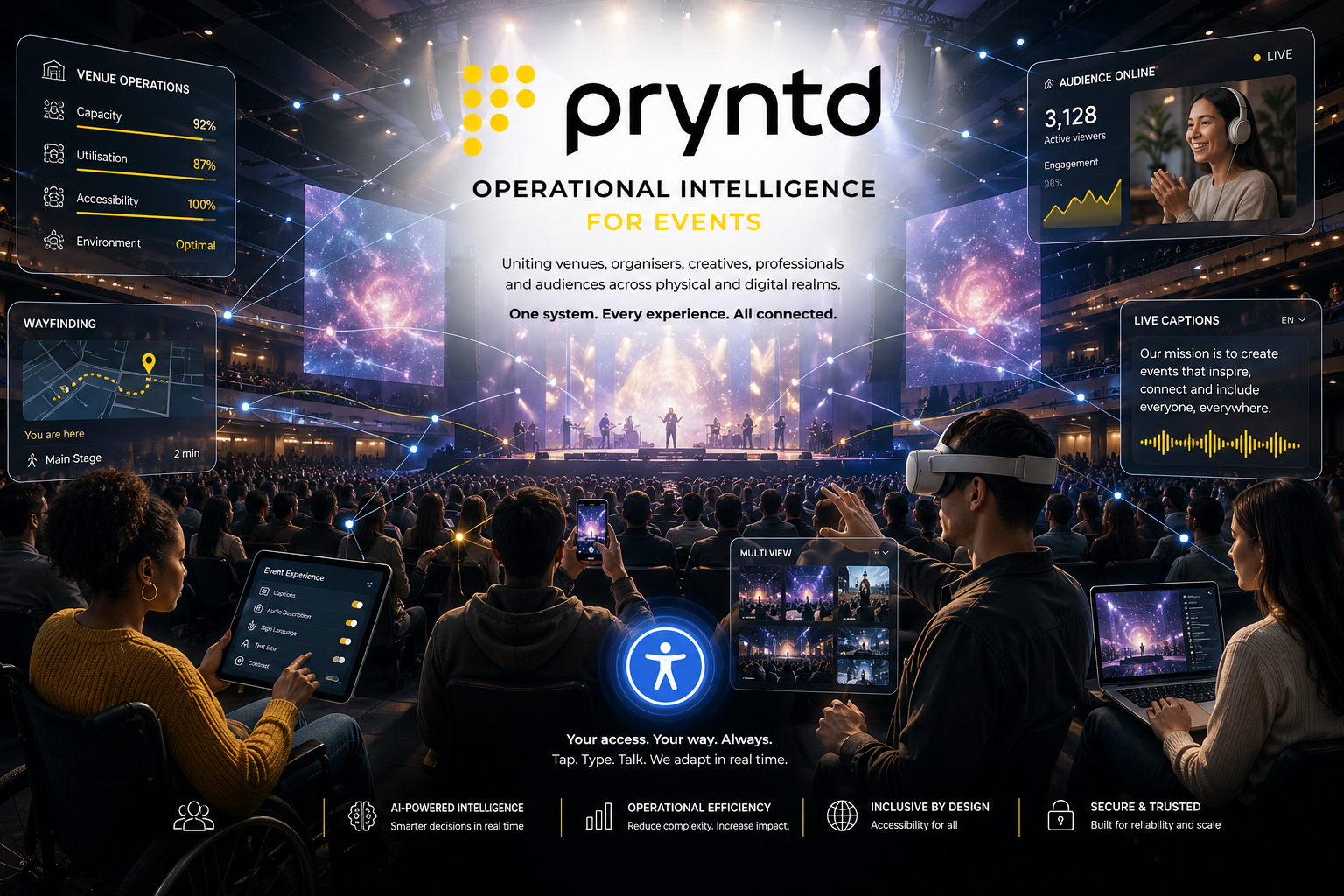
Shared reality begins with presence. Pryntd was never designed as accessibility software. It was designed as infrastructure for environments that understand human needs before friction becomes exclusion.
Explore the model
See agentic access
Presence before participation
Adaptive by default
Invisible until needed
NeedCaption-first mode
ContextQuiet route open
PresenceRemote view active
SafetyFlash risk reduced

Exclusion is caused by fragmented systems.
Disabled people are not excluded because they do not want to participate. They are excluded because the systems surrounding participation are disconnected, overstretched, and forced to treat accessibility as a separate problem.
Transport
Routes, drop-offs, step-free access, timing, assistance, and contingencies rarely live in one participant-ready flow.
Venue information
Critical details are often outdated, buried, incomplete, or separated from the moment people make attendance decisions.
Planning
Companion needs, sensory preparation, travel buffers, support requests, and arrival risk become manual admin.
Communication
Instructions, alerts, captions, changes, and on-site guidance do not adapt to how each person can best receive them.
Production
Creative teams want inclusion, but budgets, workflows, venue constraints, and fragmented tooling limit delivery.
Operations
Staffing, insurance, safety, ticketing, crowd movement, and compliance pressures compete for attention.
Digital experience
Remote and hybrid participation can feel secondary when it is not designed as part of the shared environment.
Accessibility data
Access information becomes static when the real environment is dynamic, live, and context-dependent.
Participation should not begin with a 48 hour risk assessment.
For many able bodied people, attending an event is spontaneous. For many disabled people, the same event can require transport coordination, venue checks, companion planning, sensory preparation, route analysis, communication support, environmental assessment, and contingency planning.
One personMinutes
Find the event, buy the ticket, arrive.
Another person48h
Validate safety, access, route, support, and fallback options.
Pryntd shiftNow
Make people feel present before they arrive.
1Access confidence before purchaseAccessibility information is surfaced in the decision flow, not discovered after commitment.
2Environmental previewsParticipants understand routes, rooms, sensory intensity, and participation modes before arrival.
3Adaptive communicationInformation can become captions, simplified text, spoken guidance, haptics, icons, or multilingual support.
4Hybrid continuityRemote, physical, and blended attendance are treated as connected modes of presence.
5Operational orchestrationNeeds, constraints, staff workflows, venue data, and participant intent move through one shared infrastructure layer.
The accessibility bridge is continuity.
Hybrid participation is not a compromise. It is the connective tissue between physical, digital, remote, assisted, sensory-adjusted, and immersive ways of being present.

One event. Multiple valid ways to exist inside it.
Remote access, adaptive interfaces, sensory-adjusted environments, spatial previews, and alternative perspectives become part of the environment itself.
Attend remotely without becoming secondaryThe digital participant receives context, agency, interaction, and presence rather than a passive stream.
Move between physical and digital presencePeople can shift attendance modes as energy, mobility, sensory conditions, or logistics change.
Experience environments from multiple perspectivesAlternative views, spatial context, replay, captions, and guided navigation reduce the penalty of not being in the ideal seat.
Adapt interfaces around human needsThe environment can become simpler, calmer, louder, clearer, slower, more descriptive, or more tactile.
Accessibility adapts across the whole human experience.
Pryntd treats accessibility as dynamic infrastructure across perception, cognition, mobility, communication, and sensory interaction. The result is not a checklist. It is an environment that restructures itself around the participant.
Visual and hearing accessibility
Make the environment perceivable from more than one channel.
Adaptive contrast, scalable interfaces, audio description, spatial navigation, realtime captions, multilingual transcription, subtitle positioning, and visual or haptic alerts create parallel routes into the same shared reality.
Interfaces adjust for low vision, glare, lighting conditions, and visual fatigue.
Speech becomes readable context with live timing and spatial awareness.
Visual moments can become spoken narrative without separating the participant from the event.
Important changes can be felt as well as seen or heard.
The user expresses intent. The environment coordinates itself.
Instead of forcing people to manually coordinate dozens of fragmented tasks, Pryntd moves toward an AI layer that interprets context, understands needs, and orchestrates participation.
User intent
“I want to attend this event.”
Conversational access requests become structured operational tasks.
Text input can describe needs, preferences, energy, uncertainty, or constraints.
Low-friction controls support moments when typing or speaking is not ideal.
Voice, text, icons, captions, haptics, and environmental state work together.
Preferences, saved needs, current context, sensory state, device, language, and attendance mode are interpreted together.
Transport, venue information, route planning, viewing modes, communication layers, and hybrid options become one flow.
Captions move, interface complexity reduces, sensory intensity drops, alerts shift channel, and routes update as the event changes.
Support appears when needed and disappears when not needed, without forcing people into public identity labels.
Accessibility should not other the person using it.
One of the deepest failures in accessibility design is making support socially isolating. Pryntd treats access as an ambient layer of shared reality, not as a separate lane.
People who do not need support never feel burdened by it. People who do need support do not have to fight for it.
The system understands whether the person is planning, arriving, navigating, watching, communicating, resting, or participating remotely.
Accessibility becomes a property of the environment, allowing everyone to exist together without the support layer becoming the social focus.
When fragmentation is solved, everyone operates better.
Pryntd is not trying to bolt accessibility onto broken systems. It is rebuilding the participation layer so venues, organisers, professionals, creatives, and audiences coordinate around the same shared reality.
Staff gain clearer access intelligence, fewer ad hoc requests, and more predictable operating context.
Safety, ticketing, communications, crowd movement, and accessibility are no longer separated into competing workflows.
Production, creative, access, and operational teams can work from shared context rather than isolated tooling.
Hybrid access, replay, perspective switching, and adaptive interpretation expand who can meaningfully experience the work.
Presence begins before arrival and continues across physical, digital, assisted, and remote participation.
Accessibility stops being a burden and becomes the natural outcome of intelligent infrastructure.
An event is not just a place.
It is a convergence of people, environments, systems, communication, and emotion across physical and digital space. Pryntd exists to ensure nobody is excluded from that reality simply because the surrounding systems failed to adapt to human needs.
This is not just accessibility technology. This is infrastructure for human presence. This is shared reality.