Pryntd: The Story of Shared Reality
AI Driven XR for Shared Reality
Pryntd is building shared reality infrastructure: AI driven XR experiences that work across native browsers, smartphones, tablets, computers, TVs and spatial devices without trapping access inside headset-first platforms.
The Beginning
The future seemed inevitable. The reality felt strangely small.
For decades, the promise of immersive technology felt enormous. Entire industries imagined transformation: entertainment, education, retail, construction, real estate and human interaction itself.
Yet adoption repeatedly stalled. Expensive headsets gathered dust. Grand launches underperformed. The problem was rarely imagination. The problem was access.


First Principles
Pryntd approached XR from the delivery layer.
What if the problem was never immersion itself? What if the problem was the way immersion was being delivered?
Pryntd asked whether extended reality could evolve beyond specialised hardware and become something people could access through the devices already surrounding them.


The Contraption Problem
Immersion inherited a limiting assumption.
Since Ivan Sutherland introduced the Sword of Damocles in 1968, virtual reality inherited a foundational assumption: immersion required wearing a machine.
That assumption shaped decades of XR thinking. Bigger headsets. More expensive hardware. More processing power. More isolation.
Pryntd evolved past that assumption. The future was not another closed device category. The future was shared reality across the devices people already own.

The Access Layer
XR becomes mass-market when it works through native browsers.
Pryntd is about making XR accessible on smartphones, tablets, computers, TVs and AR/VR devices without forcing every user into a dedicated headset or app ecosystem.
Links, embeds and full HTML exports make immersive environments behave like the web itself: open, shareable, portable and immediate.


Convergence Theory
The convergence theory that solidifies Pryntd’s approach.
Shared reality becomes genuinely useful when access, creation, intelligence, distribution and media formats converge into one practical system.
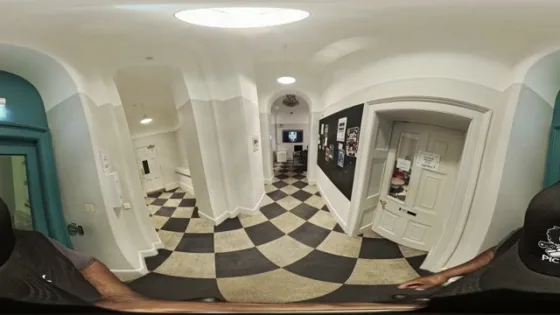
It brings together 2D media such as landscape video, portrait video, images, documents and streams with 3D media such as 360 tours, spatial captures, 3D models, CAD environments and live interactive spaces. These experiences can be on-demand, live, embedded, linked or exported as full HTML pages.
2D Formats
Landscape, portrait, images, video, documents, dashboards, training content and live streams become part of the same shared reality layer.
3D + 360
360 tours, 3D models, spatial scans, CAD files and immersive environments become browser-native and shareable.
On-Demand
Users can access spatial content when they need it: for sales, training, planning, support, accessibility or review.
Live
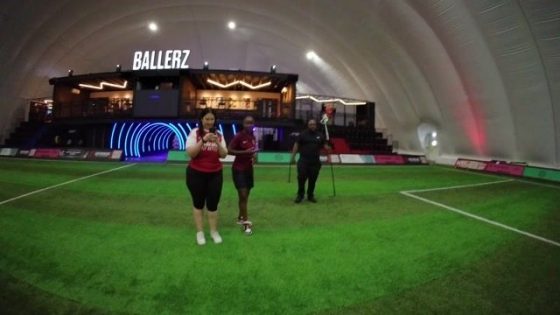
Events, cameras, operations, venues and collaborative environments can become realtime shared reality experiences.
01 Access
Browsers on phones, tablets, computers, TVs and XR devices make immersive viewing available without specialist hardware.
02 Creation
Phones, tablets, DSLRs, 360 cameras, CCTV, Ring doorbells, CAD, Luma Labs, Blender, Unity and Unreal become authoring inputs.
03 Intelligence
AI interprets scenes, assets, user needs, accessibility requirements and contextual points of view.
04 Distribution
Links, embeds and full HTML exports place contextual POVs directly within reach of users.
When AI and XR converge with 2D, 3D, 360, on-demand and live media, immersion stops being a specialist format and becomes an operational layer for entire industries.


Commercial Outcomes
The reason this matters: it helps clients make money, save money and maximise resources.
Shared reality is not useful because it looks futuristic. It is useful because it changes how organisations operate. It reduces friction, shortens decision cycles, extends reach, improves training, unlocks remote participation and turns existing assets into reusable digital infrastructure.
Operational efficiency becomes one of the clearest use cases because the same spatial layer can support sales, training, planning, accessibility, customer service, site operations and stakeholder communication without rebuilding separate systems for each team.
Make Money
Create new revenue opportunities through immersive sales journeys, virtual product demos, premium access, sponsor activations and wider audience reach.
Save Money
Reduce unnecessary travel, repeated site visits, duplicated walkthroughs, manual briefings, training overhead and expensive specialist production cycles.
Maximise Resources
Turn existing cameras, CAD files, venues, product media and operational data into reusable spatial assets across multiple departments.
Improve Bottom Line
Increase conversion, reduce waste, accelerate decisions and give teams clearer context before money, time and labour are committed.
Faster
Approvals, walkthroughs, training, customer understanding and stakeholder alignment.
Leaner
Fewer disconnected tools, fewer repeated explanations and less operational duplication.
Smarter
AI driven context turns immersive content into decision support, not just visual content.

The Evolution of Shared Reality
The story of shared reality is ultimately the story of convergence.
Not simply better graphics or more immersive media, but the convergence of human experience, intelligence, accessibility, presence and coordination across physical and digital environments.
3D → Presence
We began by challenging one of XR’s earliest barriers: accessibility and creation complexity.
We focused on turning flat 2D experiences into accessible 3D environments directly through native browsers, simplifying creation through devices people already owned, from smartphones and DSLRs to 360 cameras and everyday consumer technology.
- XR accessibility and adoption barriers
- Hardware dependency and ecosystem fragmentation
- High production complexity and cost
- Limited creator participation
- Lack of scalable browser-native immersive infrastructure
3D was about making immersion reachable. It transformed XR from a gated technological experiment into something more democratic, distributable and human.
4D → Context
Once immersive environments became accessible, another problem emerged. Most virtual experiences still lacked contextual awareness.
So we moved into contextual immersion, where environments became responsive to real world situations, physical spaces, live events, audience behaviour and dynamic interactions.
- Disconnected physical and digital experiences
- Passive audience engagement
- Lack of contextual intelligence in XR
- Fragmented event and venue systems
- Limited emotional and social immersion
Experiences were no longer just viewed. They became lived, responsive and interconnected.
5D → Human Accessibility
The next frontier was not graphics. It was human inclusion.
The convergence of AI and XR enabled us to centre accessibility and sensory augmentation, ensuring immersive environments could adapt dynamically to individual needs.
- Accessibility exclusion across events and spaces
- Sensory overload and cognitive barriers
- Physical navigation and wayfinding difficulties
- Communication and participation inequality
- Inconsistent accessibility delivery across environments
This was the moment shared reality became truly human centred. Not merely immersive. Inclusive.
6D → Proactive Collaboration
As accessibility and immersion evolved, a larger challenge appeared: coordination.
The sixth dimension focused on remote collaboration and proactive shared reality through the convergence of spatial intelligence, realtime systems and six degrees of freedom.
- Remote participation limitations
- Operational fragmentation across environments
- Delayed decision making and response times
- Inefficient coordination between stakeholders
- Limited realtime situational awareness
Shared reality evolved from immersion into coordinated intelligence. The environment itself became collaborative infrastructure.
7D → Autonomous Shared Reality
We now enter 7D: the convergence of autonomous agentic AI with collaborative shared reality systems.
AI agents can understand intent, coordinate systems, personalise environments, automate accessibility and proactively solve problems before they escalate.
- Cognitive overload in complex environments
- Accessibility coordination at scale
- Operational inefficiency and fragmented workflows
- Information saturation and decision fatigue
- Barriers to independent participation
- Resource shortages across public and private systems
Shared reality becomes proactive rather than reactive. Not simply environments people enter, but environments that intelligently support people in return.
Beyond 7D
The future holds the promise of 8D, 9D and 10D shared realities.
These are dimensions where AI, robotics, spatial intelligence, autonomous systems, biotechnology, environmental intelligence and collective human coordination converge to solve some of the world’s most critical challenges.
- Global accessibility inequality
- Healthcare delivery and ageing populations
- Climate adaptation and environmental resilience
- Education inequality
- Urban congestion and infrastructure strain
- Crisis response and humanitarian coordination
- Loneliness, isolation and social fragmentation
- Workforce displacement and economic transition
The evolution of shared reality is not about escaping the real world. It is about building systems intelligent enough, inclusive enough and human enough to improve it.
Creation Network
The world already owns the capture infrastructure.
Creation no longer has to begin with specialist studios or closed pipelines. The inputs are already everywhere: phones, tablets, DSLRs, 360 cameras, CCTV, doorbell cameras, CAD files, 3D scans, game engines and AI generated spatial assets.
The challenge is orchestration. Pryntd connects these fragmented inputs into experiences that can be viewed, shared and embedded natively.


Industry Utility
Why convergence becomes incredibly useful for industries.
Every industry manages places, assets, experiences, workflows or human movement. XR gives those environments spatial presence. AI gives them interpretation, automation and adaptability. Browser-native distribution makes them reachable.
Events
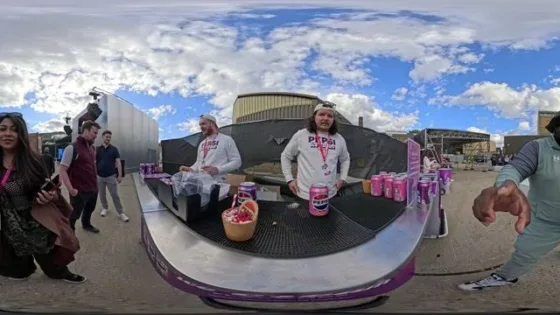
Remote attendance, venue mapping, accessibility support, crowd guidance and sponsor activations become one shared reality layer.
Retail
Products can be explored contextually through try ons, room placement, guided demos and AI assisted journeys.
Real estate
Properties become spatially explorable across browsers, tablets, phones and embedded sales pages.
Construction
CAD, site media and 3D models can become contextual walkthroughs for clients, teams and stakeholders.
Security and operations
CCTV, doorbell cameras and site feeds become spatial intelligence inputs instead of isolated video streams.
Education and training
Lessons become immersive, adaptive and accessible without requiring every learner to own specialist hardware.


Accessibility
Accessibility was never an afterthought.
Millions of people remain excluded from events, entertainment and shared cultural experiences because physical and digital environments were never designed to adapt dynamically to human needs.
If environments can become spatially intelligent, they can also become adaptive. AI driven XR can personalise experiences, adjust interfaces, adapt navigation, provide contextual assistance and bridge remote and physical participation.

The Bigger Vision
The implications extend far beyond events.
Education can become immersive and adaptive. Retail can become contextual and experiential. Real estate can become spatially interactive. Construction can visualise environments before they exist. Entertainment can become participatory instead of passive.
2D landscape
2D portrait
3D models
360 tours
Live environments
On-demand access
Education
Retail
Real estate
Construction
Entertainment
Security
Operations
Hybrid participation
Spatial intelligence
Operational efficiency
Revenue growth
Cost reduction