The Infrastructure For Shared Reality
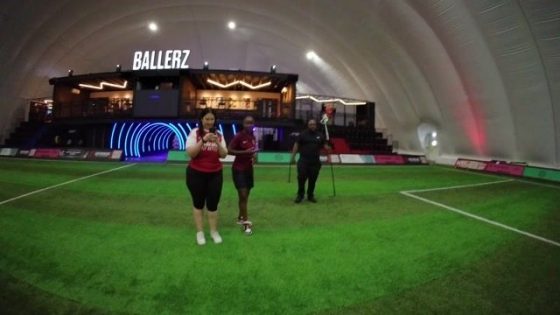
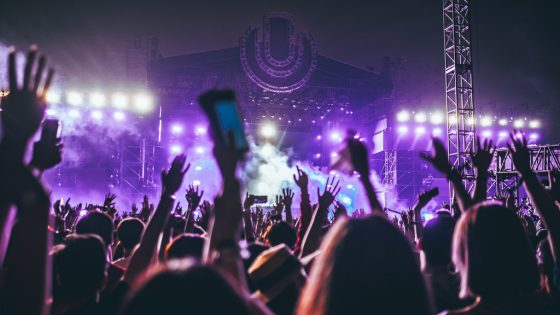
Pryntd helps venues and event organisers converge physical, virtual and hybrid audiences into a single intelligent system that transforms audience engagement, venue operations and accessibility into real-time augmentation.
Audience data lives in one platform.
Ticketing lives in another.
Streaming lives somewhere else.
Accessibility is reactive. Operations remain disconnected.
Pryntd brings everything together.
Unlock Shared Reality
Physical audiencelive participation
Remote audiencebrowser-native access
Venue dashboardoperations in context
Accessibility layeradaptation by default
Spatial map + AIreal-time intelligence
Physical + virtual + hybrid participation connected as a living system.
Events Were Never Meant To Be This Fragmented
The modern event industry runs on disconnected systems. Physical audiences are measured separately from virtual audiences. Ticketing rarely understands engagement. Streaming rarely understands venues. Venue systems rarely understand audiences.
Every disconnect creates friction. Every friction point creates inefficiency. Every inefficiency creates exclusion.
A systems problem
The industry does not lack tools. It lacks orchestration.
Each platform sees one transaction, one channel, one room or one user type. Nobody sees the whole environment while it is alive.
Fragmented inputs produce fragmented decisions.
Ticketing
Streaming
Venue data
Accessibility
Audience CRM
Operations
No shared context
of organisers report technology challenges.
struggle to connect physical and virtual audiences.
cite audience engagement as a major challenge.
of virtual attendees feel excluded.
the UK Purple Pound: disabled people and their households.
people globally experience significant disability.
Benchmarks: event challenge figures are supplied in the project brief and align with reported CEIR/Sweap and Markletic hybrid-event findings. Accessibility figures: Scope and World Health Organization.
The Experience Is The Product. The Proof. The Destination.
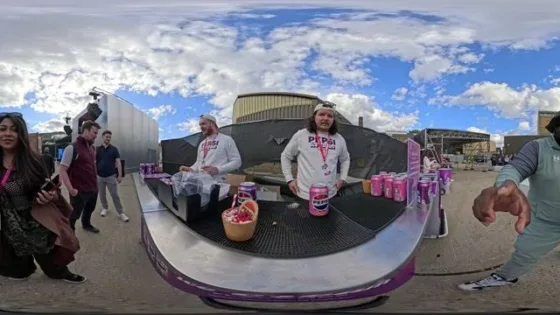
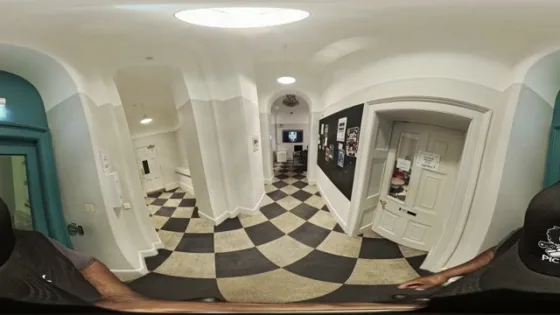
Do not just read what shared reality means. Enter it. Explore a browser-native environment where media, place, interaction and context converge.
Interactive environment
No app download required
Mobile and tablet users
Double-tap the red icon to activate motion sensing. Tap Allow when “pryntd.xyz would like to Access Motion and Orientation” appears. It brings the experience to life and lets you look around hands-free.
We Converge Human Participation
Most platforms optimise one part of an event. Pryntd optimises the entire environment by joining audiences, spaces and systems into one intelligent layer.
Audience Intelligence
Understand physical, virtual and hybrid audiences as one community, with participation visible across the whole journey.
Venue Intelligence
Understand how people interact with spaces, environments, routes and services while the experience is happening.
Continuous Access
Transform one-off ticket sales into year-round engagement, persistent communities and recurring revenue.
Operational Intelligence
Connect organisers, venues, suppliers, staff and stakeholders through one current operating picture.
Accessibility Intelligence
Remove barriers and help everyone participate in the same shared reality without creating a parallel experience.
Real-Time Augmentation
Turn live signals into immediate actions, adaptations and coordination while experiences are still unfolding.
Shared Reality Means Everyone
Pryntd is centred on the lived experiences of disabled people. We saw first-hand how fragmented systems create barriers that prevent participation.
Accessibility should not create separate experiences. Not one in four. Not three in four. Four out of four.
Inclusion means everyone can participate in the same shared reality.
CCDeaf participationCaptions and visual context connect
ADBlind participationAudio description and spatial cues
✓Shared participationOne environment, not parallel realities
Language Models Understand Text. Pryntd Understands Human Experience.
Pryntd is building spatial intelligence models that understand human experience. Starting with events. Expanding into every environment where people gather.
PeopleSpacesBehaviourParticipationAccessibilityOperationsContext
Text
Spaces
Experiences
Shared Reality
Human environment modelsSense → understand → coordinate → augment
From An Immersive Question To Spatial Intelligence
A six-year progression from making immersive experiences easier to building the intelligence layer for human environments.
2020
The founding question
Why are immersive experiences still difficult to create, distribute and monetise?
One Layer Does Not Replace The Others. It Orchestrates Them.
Pryntd connects the physical, hybrid, intelligence and AI layers so participation can be understood and improved as one environment.
Physical SpacesVenues · Festivals · Museums · Campuses · Retail
Hybrid LayerDigital twins · Streaming · Virtual participation
Intelligence LayerAudience · Venue · Accessibility · Operations
AI LayerPrediction · Automation · Coordination · Adaptation
Shared Reality LayerUnified participation
The Future Belongs To Intelligent Environments
The physical world and digital world are converging. Venues are becoming intelligent. Events are becoming persistent. Accessibility is becoming infrastructure. AI is becoming an operational partner.
Pryntd exists to power the future where participation is easier, operations are smarter, experiences are more inclusive and everyone can feel present.
Browser-native accessDigital twinsMulti-Stakeholder RBACAI-powered participationReal-time augmentationShared reality orchestration
From A Stack Of Tools To A Living System
Pryntd does not win by becoming another point solution. It wins by giving existing systems shared context, intelligence and orchestration.
| Traditional tools | Pryntd |
|---|---|
| Ticketing only | Continuous access |
| Virtual only | Physical + virtual + hybrid |
| Audience reports | Audience intelligence |
| Venue analytics | Spatial intelligence |
| Accessibility add-on | Accessibility infrastructure |
| Manual optimisation | Real-time augmentation |
| Fragmented tools | Unified system |
User-generated shared realityAccessibility-first AIMulti-Stakeholder RBACAudience intelligenceVenue intelligenceOperational intelligenceContinuous accessBrowser-nativeDigital twinsSpatial intelligenceHuman environment modelsAI-powered participation infrastructure
An Event Is A Shared Reality
An event is not a ticket.
An event is not a livestream.
An event is not a venue.
An event is not a platform.
It is a unified system where people, space and systems converge across physical and digital environments.
Unlock Shared Reality
Create, distribute and monetise accessibility-first shared reality experiences across physical, virtual and hybrid environments.
Starting with events. Powered by accessibility. Unified by AI.
The spatial intelligence layer for human environments.