Feel Present in the Dance: Accessibility First Shared Reality for Visually Impaired Students
Feel present in the dance, even beyond the visual layer
A Goldsmiths student created shared reality scene exploring how dance, space and accessibility can be experienced through audio, spatial awareness and sensory cues.
Created by students at Goldsmiths, the scene is filmed from inside a bright studio so the viewer can enter the routine through perspective, orientation, movement cues and accessible interaction.
Audio: Performer crosses from front left to centre. The mirrored wall is behind you. Your next orientation point is the yellow floor marker.
The Goldsmiths Scene
A studio you can move through, not just look at
The scene captures a dance routine from the students' own point of view inside a bright studio space at Goldsmiths.
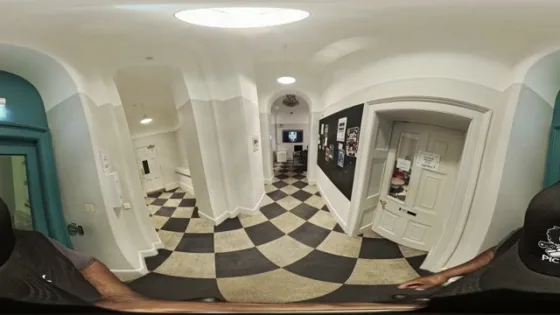
A bright dance studio with wooden floors, tall windows, mirrored surfaces, a whiteboard, open floor space and multiple viewpoints becomes the learning environment. The viewer can move between student perspectives and follow the routine from inside the space.
The scene is not just a video. It is a spatial learning environment with selectable perspectives, movement markers, sensory cues, spatial hotspots and interaction points that help the viewer understand where they are in relation to the dancers, the room and the rhythm of the sequence.
Accessibility-first shared reality
Most immersive and hybrid experiences are still designed visually first, then accessibility is added later. Pryntd changes this by making accessibility part of the experience design itself.
Image placeholder: student POV from inside the routine
Image placeholder: mirrored wall, whiteboard and floor markers
Video walkthrough placeholder
Replace with the Goldsmiths scene walkthrough, perspective switching and visual impairment mode demo.
Key Interaction
Tap the blue icon. Choose Visual Impairment. The scene adapts.
The accessibility icon at the bottom middle of the experience is not an afterthought. It is the route into a designed mode of participation.
1
Tap accessibility icon
The blue universal accessibility icon opens the access layer from inside the scene.
2
Select Visual Impairment
The viewer chooses a mode built for audio, orientation, contrast and simplified navigation.
3
Experience adapts
The scene changes how it describes movement, space, distance, rhythm and interaction.
Visual Impairment selected
Audio description active. You are standing near the centre floor marker. A dancer approaches from your right, turns towards the mirrored wall, then moves away towards the windows.
Standard visual mode is active.
- Audio description of movement
- Spatial orientation cues
- Directional sound
- Floor position narration
- Performer proximity cues
- High contrast interface
- Simplified controls
- Keyboard and screen reader support
- Reduced visual clutter
- Guided scene summaries
- Haptic ready cues for future devices
- Replay descriptions
- Slow down movement explanation
Student Benefit
Designed for students who learn through more than sight
For visually impaired students, shared reality can make dance, performance, fieldwork, spatial learning, creative practice and academic participation more inclusive and embodied.
- Dance and performance analysis
- Embodied learning
- Creative practice
- Spatial awareness training
- Inclusive lectures and workshops
- Remote participation
- Revision and replay
- Collaborative group work
- Confidence before entering unfamiliar spaces
- Independent exploration of studios, labs, venues and campuses
- Better access to fieldwork
- Practice based learning
Evidence
The need for access by design is already visible
These figures show why accessibility in spatial and hybrid learning should be treated as core infrastructure, not a late-stage compliance layer.
2.2B
WHO
people globally have near or distance vision impairment.
1B
WHO
cases could have been prevented or are yet to be addressed.
2M+
RNIB
people in the UK live with sight loss severe enough to affect daily life.
Gap
RNIB Educational Attainment 2023
RNIB reports lower attainment for pupils with vision impairment from early years through to GCSEs.
DSA
GOV.UK
UK government evidence reviews cite inaccessible university and Disabled Students' Allowance systems.
3,450
HESA-related student disability data
previous HESA-related reporting identified around 3,450 UK university students categorised as blind or having serious visual impairment.
HE
Disabled Students UK
Disabled Students UK research shows continuing accessibility gaps across higher education systems, spaces and implementation.
Universities
Why this matters for universities
Universities are under pressure to improve inclusive learning, digital accessibility, student belonging and participation.
Universities
Make physical and hybrid learning environments accessible from the beginning.
Art schools
Translate studio practice into spatial, sensory and replayable learning assets.
Dance departments
Support movement analysis through audio, rhythm, sequence and orientation.
Performance departments
Make rehearsal spaces, staging and performer relationships easier to navigate.
Accessibility teams
Move from case-by-case adaptation to reusable access infrastructure.
Student support teams
Help students build confidence before entering unfamiliar rooms and routines.
Digital learning teams
Create accessible spatial content for remote, blended and replay learning.
Campus experience teams
Turn studios, labs, venues and campuses into accessible digital twins.
Beyond Captions
Visual impairment access is not solved by captions alone
Captions can support dialogue, but a spatial performance requires much more: orientation, sequence, position, rhythm, proximity and context.
- Meaningful audio description
- Orientation
- Context
- Sequence
- Position
- Movement
- Distance
- Rhythm
- Proximity
- Emotional tone
- Interaction
For a visually impaired student, access is not simply knowing what is on screen. Access is understanding where they are, what is happening around them, and how they can participate.
Sensory Presence
How the Goldsmiths scene could evolve
The dance scene can become a test bed for richer access layers that make shared reality more personal, spatial and multisensory.
Binaural audio
Place movement, room tone and performer proximity around the listener.
3D spatial sound
Make direction, distance and environment legible without relying on vision.
AI generated audio description
Create draft descriptions of movement, space and interaction at speed.
Human reviewed creative description
Preserve artistic intent, emotional tone and inclusive language.
Movement rhythm cues
Explain timing, weight shift, tempo and transitions in the routine.
Directional narration
Guide the viewer through the room, the performer path and the next action.
Tactile and haptic extensions
Prepare future devices to translate movement into felt cues.
Personalised profiles
Store preferred description detail, contrast, navigation and replay settings.
Voice control
Let students ask for summaries, repeats, directions and perspective changes.
Audio first navigation
Make exploration possible without visual menus or dense controls.
Adaptive scene summaries
Offer short, medium and detailed explanations of what changed.
Multisensory digital twins
Represent learning spaces through sound, orientation, interaction and context.
Pryntd Positioning
Pryntd positioning
Pryntd is building spatial intelligence models for human environments, starting with accessibility. Language models understand text. Pryntd is building models that understand human experience across physical and hybrid environments where people gather. We call this shared reality.
Institutional Value
ROI for inclusive learning teams
Pryntd gives universities a practical way to build reusable accessibility into studios, campuses and hybrid teaching assets.
Improved inclusive learning
Make access part of the learning design from the start.
Better student participation
Help students join practice, critique and group work with confidence.
Reduced access friction
Lower the repeated burden of explaining, requesting and waiting.
Reusable learning assets
Turn one captured scene into a replayable teaching environment.
Accessible digital twins
Represent studios, venues, labs and campuses with accessible spatial context.
Better support for disabled students
Give support teams richer tools for orientation, preparation and participation.
Future ready hybrid teaching
Prepare for teaching that moves between physical and digital spaces.
Stronger compliance posture
Show evidence of proactive accessibility design and implementation.
Better student experience
Improve belonging, independence and confidence in unfamiliar environments.
Inclusive recruitment and retention
Signal that disabled students are expected, supported and designed for.
Make every student feel present
The Goldsmiths dance scene shows what happens when accessibility is not added at the end, but designed into the experience from the beginning.
Sources
Source cards
Evidence links used for the accessibility and higher education context on this page.
Global figures for near or distance vision impairment and preventable or unaddressed cases.
UK sight loss statistics and daily life impact.
Attainment gap for pupils with vision impairment from early years through to GCSEs.
Evidence review covering barriers, inaccessible systems and Disabled Students' Allowance issues.
UK higher education student disability categories and enrolment data used in sector reporting.
Research on ongoing accessibility gaps in higher education systems, physical access and implementation.