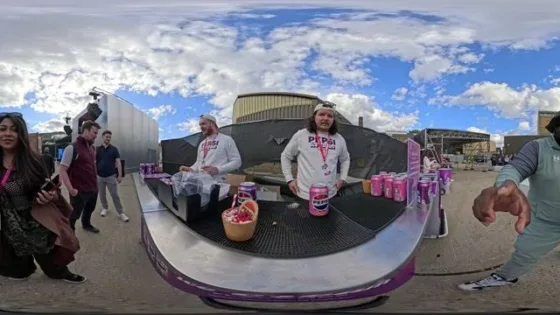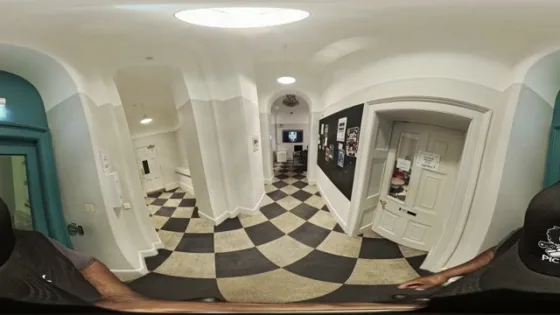
The dimensions of shared reality
Shared reality
The next evolution of human environments
Create immersive experiences. Trigger them anywhere. Participate across physical and digital worlds together.
Unlock shared reality
Browsers
Smartphones
QR codes
AI accessibility
Digital twins
The key to shared reality
Live experience
Double tap the red icon
Enable motion sensing to explore shared reality naturally by moving your device. Your smartphone already contains the infrastructure.
Double tap the red icon
Allow motion sensing. Move your phone. Enter immersive participation through the browser.
The foundation
The infrastructure already exists
For decades immersive technology promised transformation. Virtual reality. Augmented reality. Digital twins. Spatial computing. Extended reality.
Yet adoption stayed fragmented because immersive technology stayed trapped behind friction.
The industry focused on headsets. Pryntd focused on browsers.
The barrier was never imagination
- Expensive hardware
- Application downloads
- Onboarding complexity
- Specialist pipelines
- Fragmented ecosystems
- Accessibility barriers
- Technical friction
Facts and figures
The infrastructure is already global
Unique mobile users globally as of April 2026.
DataReportal
Internet users worldwide. Shared reality begins where browsers already are.
DataReportal
W3C WebXR standards enable immersive VR and AR experiences through browsers.
W3C
Modern devices contain accelerometers and gyroscopes for spatial interaction.
W3C
Immersive experiences can operate across phones, computers and XR hardware.
W3C Immersive Web
Core mechanics
Create. Trigger. Enter.
Create
One button enables anyone to upload video, embed media or livestream instantly.
360 video
YouTube
Vimeo
DSLR
CCTV
3D scans
Unreal
Unity
Blender
Trigger
Every Pryntd page automatically generates its own downloadable QR code. The physical world becomes clickable.
Enter
Users scan the QR code, enter the browser native immersive experience, double tap the red gyroscope icon and unlock shared reality.
The smartphone becomes a spatial interface. Through cardboard VR, immersion becomes even more powerful.
Contextual shared reality
Shared reality understands where you are
Traditional webpages do not understand where you are, what you are facing, what you are experiencing, how you are moving or what moment you are sharing.
Pryntd changes this.
Users are no longer sharing links. They are sharing positions, perspectives and moments.
X
Y
Z
X position0.42
Y position0.68
Z position1.24
Time00:18
Four dimensional shared reality
Interaction across space and time
Pryntd transforms video into contextual immersive environments. Interactions can appear, disappear, activate and evolve based on location, orientation, timeline, context and user behaviour.
CTAs
Contextual calls to action inside scenes.
Embeds
YouTube, Vimeo, forms, websites and live media.
3D objects
USDZ, GLB and immersive assets.
Scene portals
Move between immersive spaces.
Commerce
E commerce embedded into environments.
Livestreams
Realtime contextual participation.
Fifth dimensional shared reality
Accessibility becomes the fifth dimension
The fifth dimension transforms shared reality from immersive technology into augmented humanity infrastructure.
Environments adapt intelligently to human needs across physical, digital and hybrid experiences.
The AI layer augments humanity.
The AI adapts navigation, captions, overlays, contextual guidance, wayfinding, spatial orientation, participation systems and environmental understanding in realtime.
Sixth dimensional shared reality
Convergent reality
Physical and digital environments converge into one intelligent system across immersive media, accessibility, AI orchestration, digital twins, realtime participation, sensors, commerce and navigation.
Media inputs
Livestreams, 360 video, volumetric capture, smartphone video, DSLR and creator content.
Spatial systems
CAD, Unreal, Unity, Blender, digital twins and Gaussian splatting.
Sensor systems
CCTV, Ring cameras, IoT sensors, occupancy systems and environmental systems.
Human inputs
Voice, gestures, movement, accessibility preferences and participation behaviour.
Operational systems
Ticketing, commerce, staffing, wayfinding, venue systems and sponsorship.
Unified environment
One intelligent participatory environment for human experience.
Business transformation
Shared reality transforms industries
Venues
Operational intelligence, accessibility, hybrid participation, digital twins and realtime navigation.
Events
Immersive hybrid audiences and contextual participation systems.
Education
Experiential contextual learning environments.
Sports
Realtime immersive fan participation.
Retail
Spatial commerce and contextual storytelling.
Public infrastructure
Adaptive intelligent cities and environments.
Final close
The internet connected pages. Shared reality connects presence.
Create anywhere
Connect everything
Participate together
Pryntd is building accessibility first shared reality infrastructure where physical and digital environments converge into intelligent participatory systems across space, time and augmented human experience.
Download it, print it, place it in the world and turn that place into an entrance.
Shared reality unlocked
The red icon is the key. Enable motion sensing so your phone can become a spatial window.